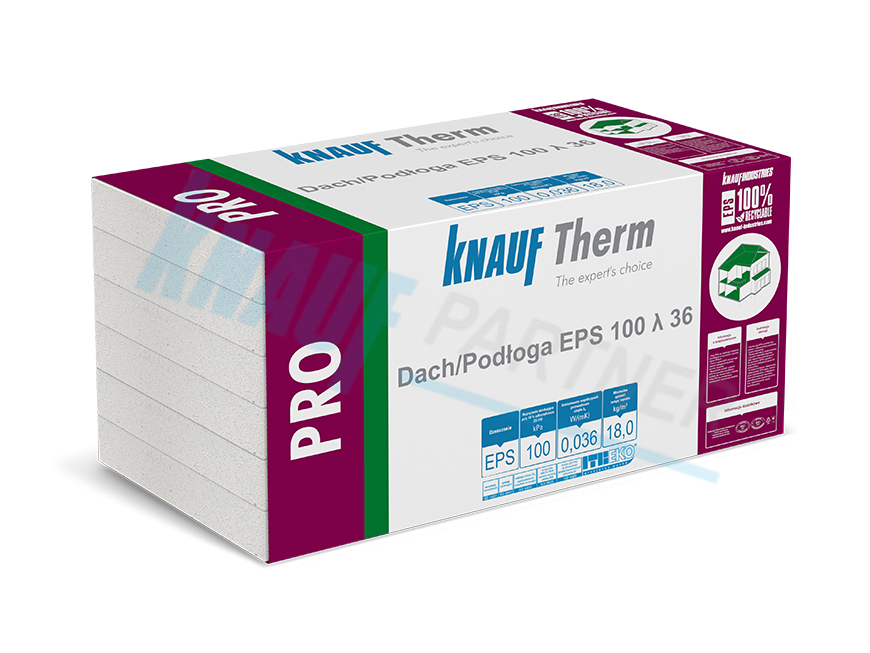






KNAUF Therm PRO Roof/Floor EPS 100 λ 36
307,50 zł
KNAUF Therm PRO Roof/Floor EPS 100 λ 36 polystyrene boards are designated by the following code in accordance with EN 13163:2012 + A1:2015.
Fast delivery
Within Poland
Safety
Careful packaging
Customer support
Contact via chat
Top quality
A trusted brand
| Dimensions | N/A |
|---|---|
| Thickness [cm] |
1 cm ,2 cm ,3 cm ,4 cm ,5 cm ,6 cm ,7 cm ,8 cm ,9 cm ,10 cm ,11 cm ,12 cm ,13 cm ,14 cm ,15 cm ,16 cm ,17 cm ,18 cm ,19 cm ,20 cm ,21 cm ,22 cm ,23 cm ,24 cm ,25 cm ,26 cm ,27 cm ,28 cm ,29 cm ,30 cm |
| Intended use |
Floor ,Roofs and ceilings |
| Lambda |
36 |
Product description
Knauf EPS 100 polystyrene is a product designed for the thermal insulation of floors and flat roofs (full-depth insulation). It is suitable for use with underfloor heating systems. Knauf EPS 100 is available from us at an attractive price per m³ – find out more about its properties now and buy the quantity you need!
Knauf Therm PRO Roof/Floor EPS 100 λ 36 polystyrene boards are designated by the following code in accordance with standard EN 13163:2012 + A1:2015.
Knauf EPS 100. Applications
Knauf EPS 100 is a versatile insulation product. It can be used as thermal insulation:
- floors beneath a sub-base of prefabricated slabs,
- floors beneath the floor covering,
- floors at ground level,
- floors in underfloor heating systems,
and also as:
- sandwich panels for walls and roofs with bitumen felt cladding,
- thermal insulation of plinths in external composite thermal insulation systems (BSO).
Knauf EPS 100 polystyrene – fixing to the substrate
Knauf EPS 100 is laid starting from the wall in the corner, adding the next panel in turn until the entire surface is covered. Remember to prepare the floor/roof properly before starting work with Knauf EPS 100 polystyrene. It is essential to check the condition of the substrate, level it and ensure that it is dry. The boards require the application of sealants to ensure waterproofing.
Permissible live loads in accordance with EN 13 163, Annex D.2 – 30 kPa, i.e. 3,000 kg/m².