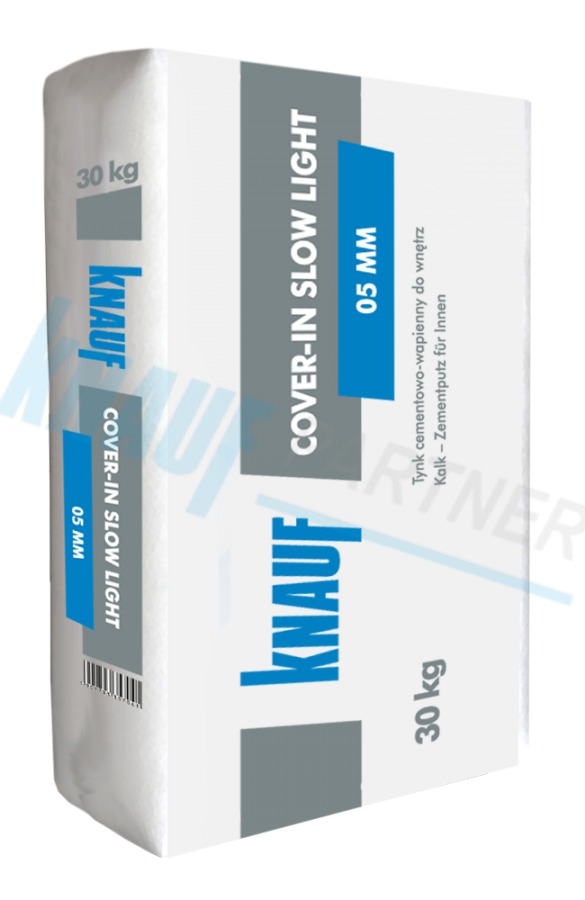
What is cement plaster and where is it used?
Cement plaster is a mortar based on Portland cement, sand and water, enriched with modifying additives. This means that, compared with other mineral plasters, it achieves the highest hardness and the best resistance to water and mechanical loads, at the cost of slightly lower workability during application.
Cement plaster is particularly suitable where maximum strength and resistance to constant exposure to moisture are essential: on building plinths, foundations, basement walls, in garages and utility rooms, as well as a base coat for waterproofing or ceramic tiling on difficult substrates. This solution is mainly used where a wall is exposed to contact with groundwater, capillary moisture or mechanical damage.
Cement plaster versus cement-lime plaster – how do they differ?
Cement plaster and cement-lime plaster are two different products in the Knauf range, each suited to different applications. Cement plaster – thanks to its higher cement content – is harder, more water-resistant and performs better on plinths, foundations and substrates subject to high levels of ground moisture.
Cement-lime plaster, thanks to the presence of lime, is more workable and easier to apply by hand, which is why it is more commonly chosen for plastering internal walls and façades on a larger scale.
If you’re looking for plaster for standard application on external walls, bathrooms or living spaces, check out
cement-lime plasters in the PK Complex range. There you’ll find Knauf products specially selected for these applications, along with a full description of their properties and specifications.
You may also want to read our post comparing different types of plaster, which will help you choose the right material:
Gypsum plaster or cement-lime plaster – a comparison.
Properties of Knauf cement-based plasters available from PK Complex
Hardness and mechanical strength
The high cement content gives this cement plaster the greatest hardness of any of the mineral plasters available in our range. It is a material resistant to scratches, impacts and abrasion, which is why it is ideal for high-traffic areas such as garages or utility corridors.
Resistance to water and ground moisture
Cement plaster absorbs virtually no water by capillary action – once set, it forms a dense, low-water-absorption structure. This makes it the material of choice wherever a wall is in direct contact with groundwater: on foundations, plinths and in cellars.
Shelf life and setting time
Cement plaster sets and hardens gradually – it reaches its full mechanical strength after approximately 28 days. Knauf products in this range comply with the requirements of the PN-EN 998-1 standard. Do not accelerate drying with heaters, nor expose freshly applied plaster to direct sunlight or frost.
How do you properly prepare the substrate for cement plaster?
Step 1. Clean the substrate – remove dust, loose particles, formwork oils and residues of release agents. The substrate must be stable and free from contaminants.
Step 2. Assess absorbency and dampness – pay particular attention to the presence of ground damp on foundations and plinths; if necessary, install damp-proofing beforehand.
Step 3. Prime highly absorbent substrates – apply a deep-penetrating or bonding primer to concrete, brick or old walls, and wait at least 12–24 hours before plastering.
Step 4. Use guides for larger surfaces or when applying by machine – they will ensure an even layer thickness.
Step 5. Ensure the right application conditions – do not plaster at temperatures below +5°C or above +30°C. Protect fresh plaster from direct sunlight and frost for at least 24 hours.
Knauf cement-based plasters with a lowest price guarantee
Prices for Knauf cement-based plasters in the PK Complex range start at around 24 zł per 30 kg bag. For larger orders – for foundations, plinths for entire buildings or multi-family housing projects – prices are negotiable. Please contact us before placing your order, and we’ll tailor our offer to the scale of your project.
PK Complex offers a lowest-price guarantee, so you can be sure you’re getting the best value for money. We’re an official Knauf partner, so when you buy from us, you’re getting genuine products with a full manufacturer’s warranty.
Not sure how many bags to order? Get in touch with us! We’ll help you calculate the area and advise you on how much material you’ll need.
FAQ – Frequently asked questions about Knauf cement-based plasters
How does cement plaster differ from cement-lime plaster?
Cement plaster contains more cement and less, or no, lime, making it harder and more water-resistant – it is mainly used on plinths, foundations and substrates exposed to high levels of damp. Cement-lime plaster is more workable and easier to apply, which is why it is more commonly chosen for plastering internal walls and façades.
What is cement plaster used for?
Cement plaster is primarily used on foundations, plinths, basement walls, in garages and utility rooms, and as a base coat beneath waterproofing or cladding on difficult and heavily loaded substrates.
How long does cement plaster take to dry?
Cement plaster is ready for further treatment after approx. 24–48 hours, whilst it reaches its full mechanical strength and water resistance after approx. 28 days. Drying time depends on the temperature, relative humidity and the thickness of the applied layer.
Is cement plaster suitable for use on a façade?
Cement plaster can be used on plinths and the lower sections of façades exposed to ground moisture and mechanical damage. For plastering the rest of the façade, cement-lime plaster is usually chosen – it is easier to work with over large areas.
What is the recommended thickness of cement plaster for foundations and plinths?
The standard thickness of cement-based plaster on foundations and plinths ranges from 10 to 20 mm, depending on the condition of the substrate and the required protection against damp. The maximum thickness for a single application is always specified in the technical data sheet for the specific product.