






Cement-lime plasters


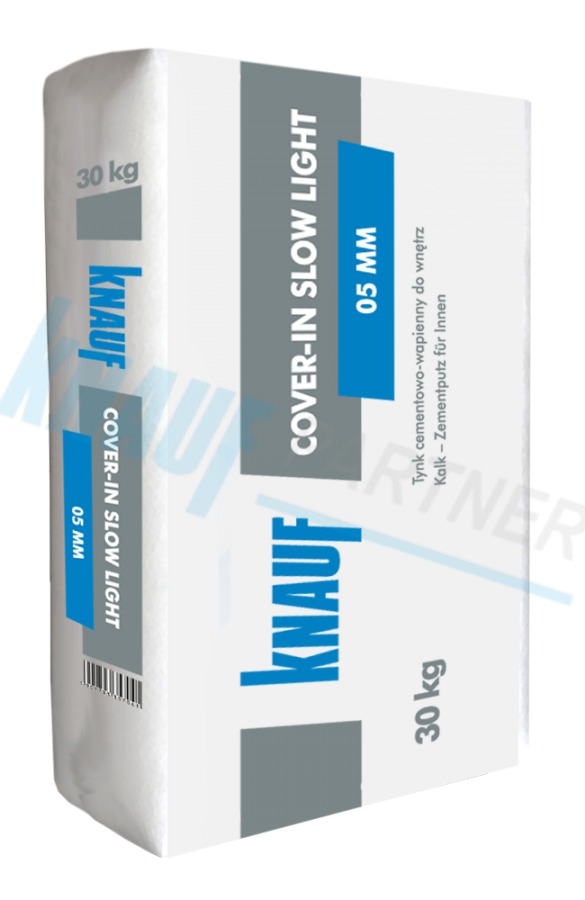

Showing all 4 resultsSorted by latest
Cement-lime plaster is a mixture of cement binder, slaked lime and aggregate – most commonly quartz or limestone sand. The standard proportions are approximately 1 : 1 : 6 (cement : lime : sand), although specific Knauf products may vary slightly from this.
What are the benefits of choosing this material:
A bag typically weighs 25 or 30 kg. For a 1 cm-thick layer, you will use approximately 10–14 kg/m² – you can calculate the exact amount required for your surface using the calculator provided with the product. Allow at least 24 hours to pass between coats; the plaster reaches its full strength after 28 days. Specifications vary between products, so always check the technical data sheet for the specific Knauf plaster before purchasing.
Not every wall requires the same material. Cement-lime plaster is a better choice than gypsum plaster when:
Not sure which one to choose? Read our detailed post: Gypsum plaster or cement-lime plaster – a comparison.
Machine-applied plasters are products designed for use with plastering machines – they have a different grain size and higher water retention than their hand-applied counterparts. As a result, a team of two workers using a machine can apply plaster to as much as 150–200 m² a day, and the finish is uniform across the entire surface.
This solution is cost-effective when building a house, renovating an entire floor or working on other large areas exceeding 200 m² – the lower labour costs quickly offset the cost of hiring the equipment.
If you’re looking for a quick alternative to dry interiors, do have a look at our machine-applied gypsum plasters.
Applying plaster by hand – using a trowel and plastering trowel without a power trowel – is still the best option for small areas, touch-ups and hard-to-reach places – as well as when you don’t want to invest in hiring a machine. It takes longer than machine-applied lime-cement plastering, but it’s accessible to anyone carrying out their own renovation work.
Facades are the most common application for this material – cement-lime plaster withstands rain, repeated freezing and UV radiation (although it will eventually need to be painted or finished). It works well on silicate blocks, solid bricks, aerated concrete (provided it is primed) and ceramic hollow blocks.
Apply it to the façade in a layer 10–20 mm thick, usually in two stages: a rough coat, followed by the main coat. Before you start plastering the façade, be sure to prime the substrate – read on to find out how to choose the right primer for the substrate.
Bathrooms, kitchens, utility rooms or garages – wherever damp is a constant or recurring problem, cement-lime plaster works better than gypsum plaster. It is vapour-permeable, but it is not a damp-proof barrier – in the bathroom, apply a waterproofing layer, such as liquid membrane, before laying the tiles.
A typical layer layout is as follows: cement-lime plaster as a levelling layer, liquid membrane, and finally ceramic tiles. Do not use gypsum plaster in wet rooms – it cannot withstand constant damp.
The plaster usually takes 12–24 hours to dry before it is ready for rendering – you’ll find the exact time on the packaging of the specific product.
For machine-applied plaster, you’ll need a plastering machine (rental costs around 100–200 zł per day), a hose, a nozzle and a steel trowel for finishing. For manual plastering, all you need is a trowel, a steel or sponge float, an aluminium straightedge for skimming off excess plaster, and a drill with a mixer attachment for preparing the mortar.
There’s a consumption calculator for every product – you’ll know straight away how many bags to buy, with no guesswork and no buying too much. A handy tip: allow for a little more material than the calculator suggests – 10% extra for trims, corners and natural wastage is a sensible margin. For larger orders, prices are negotiable – get in touch and we’ll provide you with a personalised quote.
For façades, choose C-W plasters marked as class CS III or CS IV (higher hardness) and with frost resistance (designation ‘F’ in standard EN 998-1).
Yes – but only products labelled „for power mixers" or „for machine use". Do not mix hand-applied plaster with machine-applied plaster – differences in water retention and setting times may cause problems. Look for the „M" (machine) marking on the packaging or in the technical data sheet.
Interior: 10–15 mm (1–2 layers). On façades: 15–20 mm. The minimum thickness of a single coat is approx. 5 mm, and the maximum thickness without reinforcement mesh is usually 15 mm. For thicknesses greater than this, use fibreglass mesh to prevent cracking.
The price of a 25–30 kg bag on knaufpartner.pl is approximately 24–36 zł. Coverage is approximately 10–14 kg/m² for a thickness of 1 cm. For larger orders, you can negotiate the price – please contact us.
Essentially, it is the same material – the difference lies solely in the terminology and the proportions of the binders. „Cement-lime" means more cement (harder, greater mechanical strength), whilst „lime-cement" means more lime (more plastic, easier to work with, better breathability). In practice, both terms are used interchangeably by contractors and suppliers.
 BESTSELLERS
 Mineral wool – Knauf Insulation
 TOOLS
 KNAUF THERM POLYSTYRENE FOAM
 AQUAPANEL systems
 Tiling systems
 TECTEM® internal thermal insulation systems
 External thermal insulation systems
 Flooring systems
 Plasterboard systems
 Plastering systems
 Finishing systems
Nie masz jeszcze konta?
Załóż konto