






Blog
Knauf MP 75 – machine-applied gypsum plaster: properties, applications and how to use it

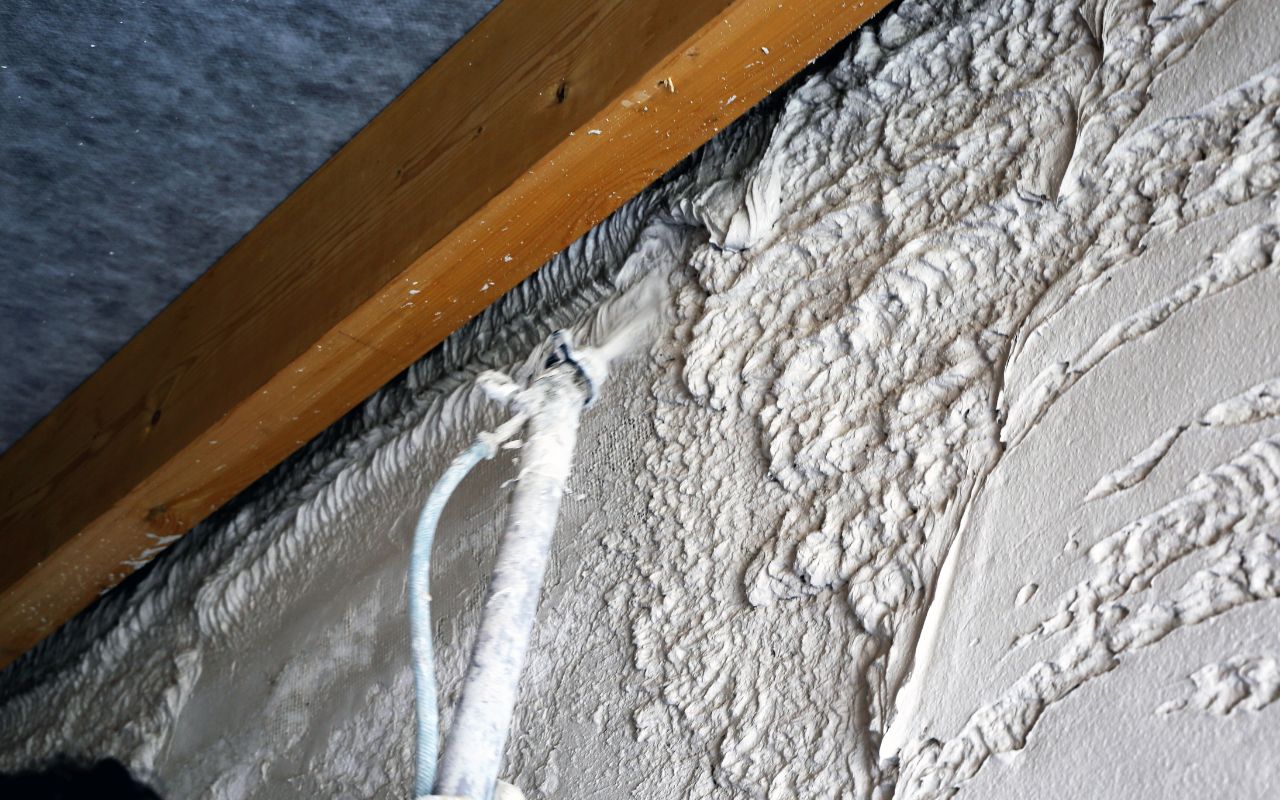
Knauf MP 75 is a machine-applied gypsum plaster for interiors – quick to apply, efficient on large surfaces and available in several variants. Find out how it differs from Rotband, how much material you’ll need and how to apply machine-applied plaster correctly.
Table of contents
What is Knauf MP 75 machine-applied gypsum plaster?
MP 75 is a ready-mixed dry gypsum plaster designed for applying single-layer interior plaster finishes using a plastering machine. It can be applied to typical mineral substrates, including ceramic bricks, hollow blocks, silicate blocks, aerated concrete and concrete, provided the surface has been suitably prepared. The manufacturer recommends MP 75 as a basic machine-applied gypsum plaster for standard internal applications.
Why is plaster a good choice for interiors? Firstly, it allows you to achieve a relatively smooth surface without the need for thick finishing coats. Secondly, the material is hygroscopic, meaning it can absorb excess moisture from the air and release it as conditions in the room change. Gypsum plasters are also easy to work with and allow for efficient application over large areas.
However, the intended use of the product is important. Knauf MP 75 is a plaster for interior use and standard conditions. For wet rooms, the manufacturer recommends, amongst other products, the specialised MP 75 Aqua; therefore, the standard MP 75 should not be treated as a substitute for a system designed for wet areas.
If you have a power generator and are planning to plaster a large area, check Knauf MP 75 machine-applied gypsum plaster – Before buying, it’s worth comparing the current price, availability and performance of the product.
MP 75 vs Rotband – which one should you choose?
Knauf MP 75 and Rotband are not products designed for exactly the same method of application. MP 75 is a machine-applied gypsum plaster optimised for application using a plastering machine. Rotband, on the other hand, is a hand-applied plaster that can also be applied by machine, which is why it offers greater flexibility for smaller jobs. The manufacturer also highlights Rotband as a particularly useful solution for more challenging, non-absorbent substrates, such as smooth concrete.
In terms of consumption, the difference is not as great as it might seem. For MP 75, the figure is approximately 8.5 kg/m² for a 10 mm layer, whilst for Rotband, the manufacturer states an average of around 8 kg/m² for the same thickness.
The choice is therefore often determined not by the price of the bag itself, but by the method of application. For areas of several hundred square metres, a sprayer allows the material to be applied much more quickly and reduces the amount of manual labour required. If, on the other hand, you only have one wall to cover, a few touch-ups to do, or you don’t have a sprayer, Rotband may be a more convenient solution.
In a nutshell: Choose the MP 75 if you have a power pack and a large area to cover. The Rotband is a better option for smaller jobs or when you need a product for manual application.
The decision on which option to choose depends primarily on the size of the area, the equipment available and the method of carrying out the work. And if you’re still in doubt, read our post: Machine-applied or hand-applied gypsum plasters – which should you choose?
Variants: MP 75, MP 75 L, MP 75 Diamant, MP 75 G/F Therm – differences
MP 75 This is the standard version for typical interior plastering work. It is designed for the machine application of single-layer gypsum plasters on mineral substrates. This variant is suitable for use in most standard flats, houses and other premises under normal conditions of use.
MP 75 L It is a lighter version of machine-applied gypsum plaster. Thanks to the use of lightweight aggregates, it is lighter in weight and easy to work with. The manufacturer recommends it for use on walls and ceilings, amongst other things, as well as on various substrates, including aerated concrete, ceramic blocks and lime-sand blocks.
MP 75 Diamant This is the ideal choice for areas where the surface will be more exposed to impacts, abrasion and other mechanical damage. Its high hardness and durability make it ideal for use in, for example, corridors, stairwells, schools, offices and garages.
MP 75 G/F Therm It is a specialised machine-applied gypsum-lime plaster designed primarily for use on wall heating systems. Its formulation has been developed to work well with the heating system and to conduct heat into the room. It should therefore not be regarded as a universal substitute for the standard MP 75.
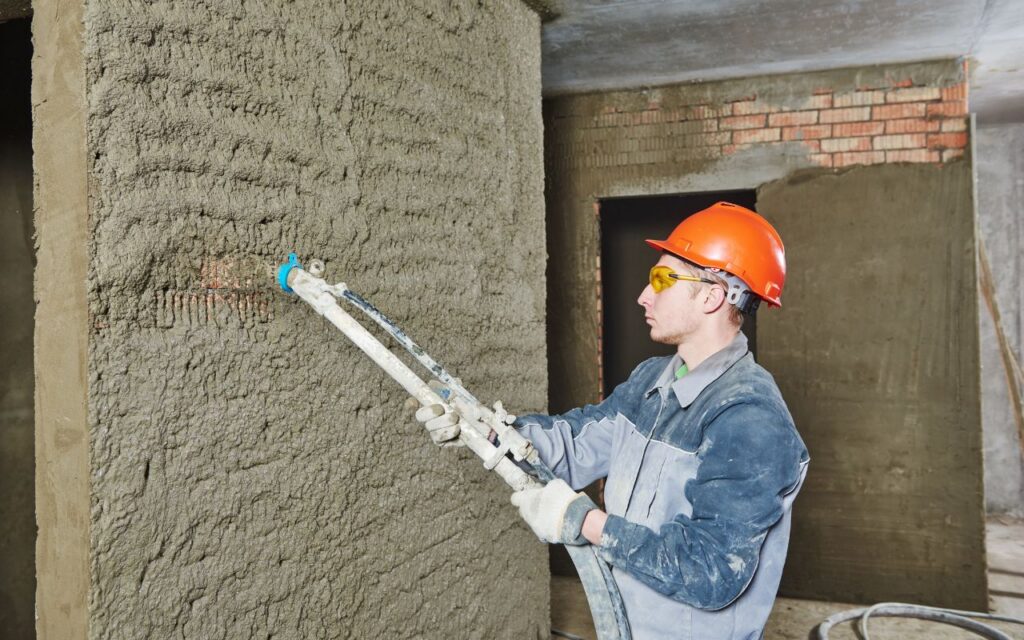
Technical specifications of Knauf MP 75
When buying plaster, it is not worth basing your decision solely on the price per bag. Far more important factors are the coverage at the intended thickness, the method of application, the scope of use, and the time required to apply and allow the surface to dry.
Layer thickness: min. 5 mm, max. 30 mm
When planning the work, it is essential first and foremost to check the requirements set out in the current technical data sheet for the specific product. For the standard MP 75, the scope of application depends on the substrate and the location of use, whilst the manufacturer’s documentation on machine-applied plaster technology also indicates application thicknesses of up to 50 mm for selected variants of the system. Therefore, the parameters for MP 75 L, Diamant or G/F Therm should not automatically be applied to the standard MP 75.
With typical brick walls, a layer of around 10–15 mm is often sufficient to level the surface. If the wall has greater irregularities, the contractor should assess whether a thicker layer can be applied in accordance with the product documentation, or whether additional measures will be necessary.
One advantage of the machine is its ability to apply mortar evenly over a large area. However, the final thickness still depends on the preparation of the substrate, the positioning of the guides and the subsequent levelling of the plaster.
Material consumption per m² and setting time
For the MP 75, the figure is taken to be approximately 8.5 kg/m² for every 1 cm of thickness. With a layer thickness of 1.5 cm, this works out at approximately 12.75 kg/m². This means that, theoretically, a 30 kg bag is sufficient to cover approximately 2.35 m² at that thickness.
For larger orders, it is advisable to calculate the amount of material required based on the actual average thickness of the plaster, rather than the maximum localised loss. It is a good idea to add a small allowance to the total to account for wastage and variations in the geometry of the walls.
The working time depends on site conditions, temperature, humidity and the method of application. It is generally assumed to be around 45–60 minutes at a temperature of approximately +20°C, but this should not be regarded as a guaranteed working time under all conditions. The warmer and drier it is, the faster the material may lose its workability.
You need to allow considerably more time for drying than for the actual application. A rough guideline of around 7 days per 1 cm of thickness under standard conditions may be helpful when planning the schedule, but before painting, you should assess the actual moisture content of the plaster rather than relying solely on the number of days.
Fire resistance and sound insulation – what are the benefits?
Plaster is a non-combustible material, but this does not mean that the plaster itself automatically confers a specific fire resistance class on the entire wall. Fire performance must always be assessed for a specific partition and the complete system solution.
Gypsum plaster also affects acoustic comfort and the indoor microclimate. However, it is not possible to assign a single universal value for the improvement in sound insulation provided by MP 75 – this depends, amongst other things, on the type of wall, its mass, the thickness of the plaster and the overall structure of the partition.
It is, however, worth noting that gypsum is hygroscopic. The material can help regulate the relative humidity of the air in a room, which is one of the characteristics that distinguishes gypsum plasters from some traditional cement-based renders.
How do you prepare the substrate for Knauf MP 75?
Even the best plaster will not rectify mistakes made during the wall preparation stage. The substrate must be stable, clean and properly prepared in terms of absorbency and adhesion. The manufacturer recommends selecting a primer appropriate to the type of surface.
What types of substrate are suitable – concrete, brick, concrete blocks?
MP 75 can be used on a wide range of mineral building substrates, including ceramic bricks, ceramic hollow blocks, silicate blocks, aerated concrete and concrete substrates, provided they have been properly prepared.
Before plastering, remove dust, loose bits of mortar, grease, dirt and anything else that might reduce adhesion. Particular attention should be paid to very smooth surfaces and highly absorbent substrates. Aerated concrete or dry ceramic substrates may draw water from the mortar too quickly and therefore require appropriate preparation.
At corners, where different materials meet, and in areas particularly prone to stress, it is also necessary to apply the reinforcement measures specified in the construction specifications.
When should Knauf Tiefengrund or Betokontakt primer be used?
Knauf Tiefengrund It is primarily used to even out the absorbency of the substrate. It is useful on surfaces that quickly absorb water from the mortar, as the water being drawn away too quickly can hinder the plaster from setting properly.
Knauf Betokontakt It is designed for smooth, dense and low-absorbent concrete substrates. It contains quartz sand, which helps to create a layer that improves the plaster’s adhesion to difficult surfaces.
You can find more information in the article how to choose the right primer for the surface to be plastered.
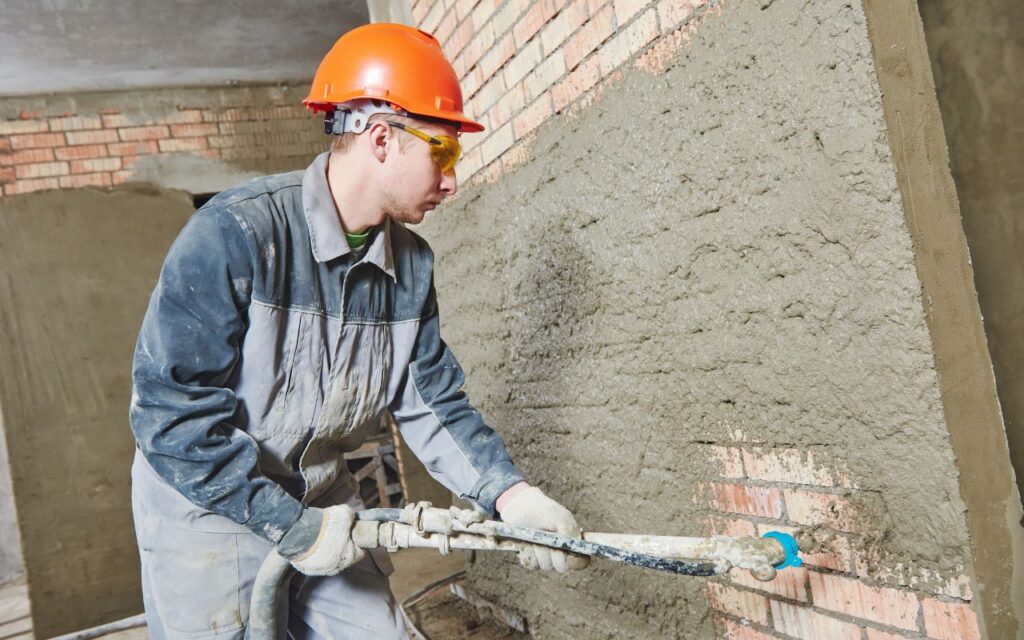
Step by step: machine-applied plastering with Knauf MP 75
Machine-applied rendering allows large areas to be covered quickly, but requires the machine to be set up correctly and the work to be well organised. Simply feeding the mortar through the hose is only the start – setting the correct thickness, levelling and subsequent finishing are just as important.
Mixing and settings for the plastering unit
- Prepare the generator. Check that the nozzle, hoses and mixing chamber are clean. Select the nozzle diameter and other settings in accordance with the instructions for the specific unit and the material’s documentation.
- Set the correct amount of water. When preparing the mortar, follow the instructions on the current packaging and the MP 75 technical data sheet. Do not increase the amount of water yourself simply to make the material come out of the nozzle more easily – excess water may impair the mortar’s performance.
- Check the consistency. The mortar should be homogeneous and sufficiently workable. If, on a test surface, the material runs or is difficult to maintain at the specified thickness, the settings must be adjusted in accordance with the machine’s instructions.
- Adjust the operating parameters. The pressure and flow rate of the pump depend on the model of the unit, the length of the hose and the conditions on site. There is no single setting that is suitable for every machine.
- Apply evenly. Keep the nozzle at a constant distance from the wall and apply the material in strips to ensure an even coat. When working on a large surface, it is particularly important to maintain a steady pace.
Plastering time and removing plaster – practical tips
Once the mortar has been applied, you must level it out promptly. The plaster is smoothed with a trowel, checking the flatness of the wall and filling in any areas where there is not enough material.
The surface is then treated in accordance with the manufacturer’s instructions. The timing of the next stage depends on how quickly the mortar begins to set. It is not advisable to rely solely on the clock – the temperature and humidity on site have a direct impact on the behaviour of the material.
You should also avoid allowing fresh plaster to dry out too quickly. Strong draughts, very high temperatures or direct sunlight can disrupt the drying process. Once the work is complete, the unit and hoses must be thoroughly cleaned before the plaster dries.
Where can I buy Knauf MP 75 and how much does it cost?
If you need a standard plaster for machine-applied finishing of walls and ceilings, MP 75 is one of the core products in our range of Knauf machine-applied plasters. The manufacturer classifies it as a standard plaster for interior use.
The price of the material may vary, so please check the current price directly on the product page. For larger projects, it is also worth comparing the cost of the material with its actual consumption per square metre.
Knauf MP 75 – check the price and order
The consumption calculator provided with the product is a useful tool when planning your order. It makes it easier for you to estimate the number of bags you’ll need, taking into account the surface area and the planned layer thickness.
If you need a different solution, do have a look at the other resources in this category: Knauf plasters – the full range and compare products designed for standard and specialist applications.
FAQ – frequently asked questions about the properties of MP 75 plaster
Is the MP 75 suitable for the bathroom?
Knauf MP 75 is designed for interiors with standard conditions of use; therefore, it should not be used directly in wet areas. If you need gypsum plaster for a room with high humidity, choose a product designed for such conditions, e.g. Knauf MP 75 Aqua.
How many bags of MP 75 are needed per square metre for a thickness of 1.5 cm?
With a consumption of approximately 8.5 kg/m² per 1 cm of thickness, a 1.5 cm layer requires approximately 12.75 kg of material per 1 m². A 30 kg bag is therefore theoretically sufficient for approximately 2.35 m² of such a surface. When ordering material, you should allow for extra to account for the actual geometry of the walls and wastage during the work.
How long does MP 75 take to dry before painting?
As a rough guide, allow approximately 7 days’ drying time per 1 cm of thickness under standard conditions, but this is only a reference point for planning the work. The actual time depends, amongst other things, on the thickness of the plaster, the temperature, the humidity and the ventilation. Before painting, you must ensure that the surface is completely dry and meets the requirements for further finishing.
Can MP 75 be applied by hand?
Knauf MP 75 is a product designed for machine-applied plastering and should be used in accordance with the manufacturer’s current documentation. If you do not have a plastering machine and wish to apply the plaster by hand, a product designed for such application, such as Knauf Rotband, would be a better option. Rotband is formulated as a hand-applied plaster, although it can also be applied by machine.
How does the MP 75 differ from the MP 75 Diamant?
MP 75 Diamant is a specialised variant offering increased hardness and resistance to mechanical damage. The standard MP 75 is designed for typical indoor applications, whilst the Diamant is worth considering where walls will be subject to heavy wear and tear, e.g. in stairwells, corridors, schools, offices or garages.


