






Blog
Mineral wool for sound insulation – how to soundproof walls, floors and ceilings?

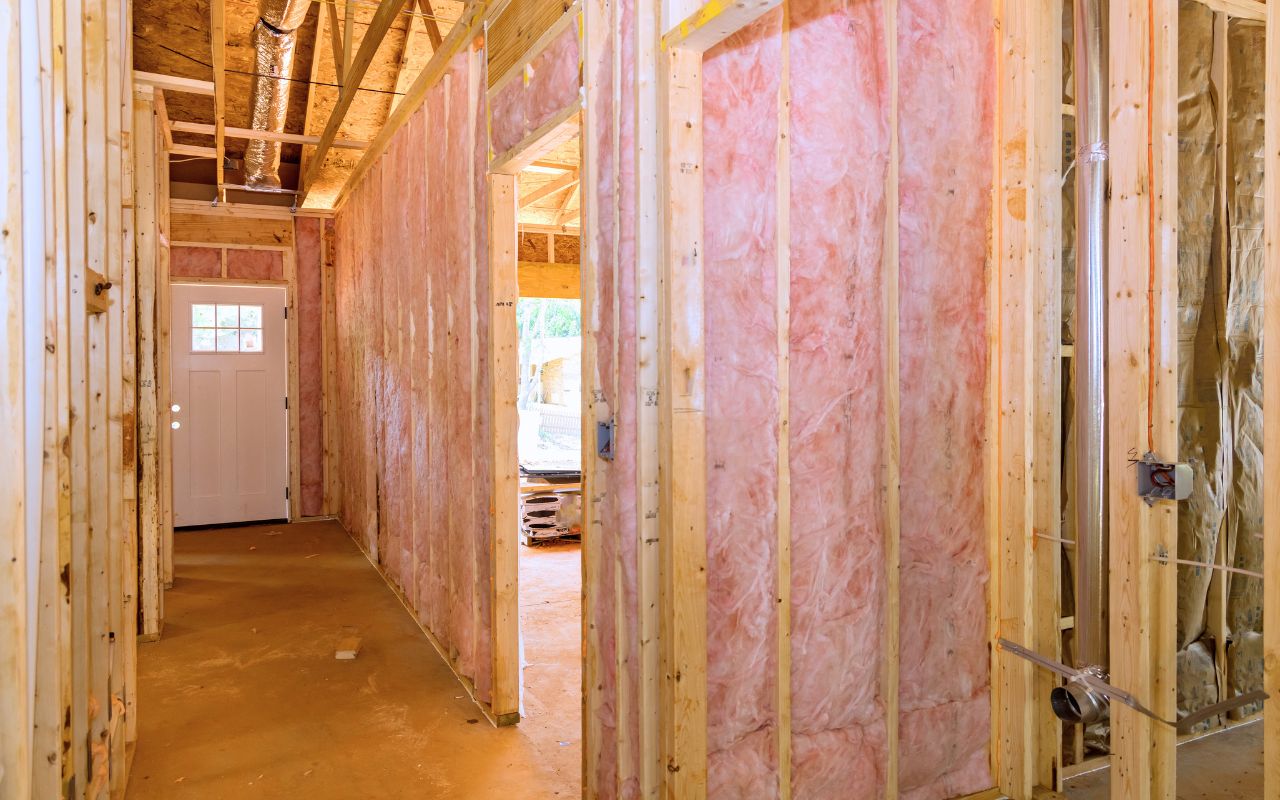
Mineral wool is one of the most effective and cheapest materials for soundproofing rooms. Read on to find out more about the properties of mineral wool – read a comparison of glass wool and rock wool, discover Knauf’s products and learn how to install mineral wool in walls, ceilings and floors!
Table of contents
Does mineral wool really soundproof rooms?
Yes, but its effectiveness depends primarily on how it is used. Mineral wool has a fibrous, porous structure. Sound waves penetrate between the fibres, and their energy is partly absorbed and converted into small amounts of heat as a result of friction within the material’s structure. As a result, the wool reduces the transmission of sound through partitions.
It is, however, worth distinguishing between sound absorption from sound insulation. Absorption reduces reflections and echoes within a room. Sound insulation, on the other hand, involves limiting the transmission of sound from one room to another. In the latter application Knauf mineral wool It works best as part of a complete system, e.g. a wall comprising plasterboard, a grid and fibreboard.
Acoustic insulation using mineral wool is particularly effective for airborne sounds, such as conversation, music, the television or the sounds of appliances. Impact sounds, such as footsteps, furniture being moved or objects being dropped, are much more difficult to deal with. In such cases, additional solutions are needed to limit the transmission of vibrations, primarily a floating floor or appropriate vibration-isolating layers.
If you’re interested in soundproofing interiors, and not just the use of wool, do have a read of our post as well Soundproofing rooms – what you need to know.
Thermal insulation vs sound insulation – how do they differ?
The same mineral wool can both reduce heat loss and improve the acoustic properties of a partition. When choosing a material, however, you should consider different parameters depending on which effect is most important to you.
In thermal insulation, the key parameter is thermal conductivity coefficient λ, expressed in W/(m·K). The lower the λ value, the better the thermal insulation properties of the material.
In acoustics, however, the analysis focuses primarily on the parameters of the entire partition, such as Rw, i.e. the weighted sound insulation index, and ΔRw, which indicates the improvement in thermal insulation resulting from the use of a particular solution. The thickness, elasticity and properties of the wool used, as well as the construction of the wall or ceiling, are also significant.
Therefore, the term „acoustic mineral wool” does not simply refer to a product with the highest density. In many lightweight structures, flexible glass wool with a relatively low density works very well. What matters is matching the material to the specific partition.
The Rw and ΔRw indices – how to interpret the acoustic properties of wool?
Rw specifies the sound insulation performance of the entire partition in decibels. This is not a parameter relating to the insulation wool itself. If the manufacturer specifies the Rw value for a wall, this value applies to a specific system comprising, amongst other things, profiles, boards, insulation wool and the method of installation.
ΔRw It does, however, allow us to assess how the use of a particular solution affects thermal insulation performance compared with the baseline design. The higher the value, the greater the improvement in that parameter for a given system.
As a rough guide, the following correlation can be assumed between the thermal insulation performance of a partition and perceived comfort:
| Partition tear | Practical experience |
| < 35 dB | Normal conversations can be heard clearly |
| 35–45 dB | Conversations and louder sounds can be heard, but they are less clear |
| 45–55 dB | Significantly improved acoustic comfort during typical use |
| > 55 dB | A high level of thermal insulation, which also depends on the overall structure |
When designing a building, one must refer to the requirements applicable to a specific partition, including the PN-B-02151-3 standard. It is therefore not enough simply to buy „thicker” insulation to automatically achieve a specific Rw value. The final result depends on the overall system and the quality of the installation.
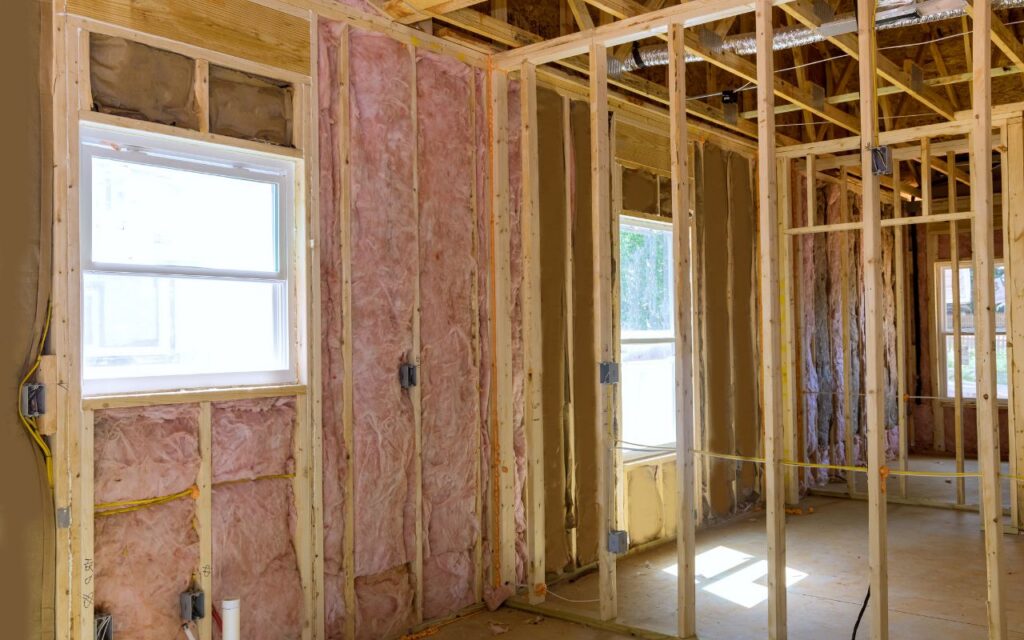
Glass wool or rock wool for sound insulation?
Both glass wool and rock wool can effectively improve sound insulation. However, they differ in terms of structure, rigidity, weight and typical applications. The choice should be based primarily on the type of partition, the required mechanical strength and the method of installation.
If you’d like to find out more about the differences between these materials, read Rock wool or glass wool – which should you choose?.
Acoustic properties of Knauf glass wool (Unifit, Naturoll)
Glass wool is lightweight, flexible and easy to fit between structural elements. This makes it well-suited for use in plasterboard partition walls, suspended ceilings and other lightweight structures where it is important to fill the space tightly.
An example is Knauf Unifit 032, glass wool with a declared λ value of approximately 0.032 W/(m·K), available in various thicknesses. Depending on the specific variant, it can be used between elements of roof structures, partition walls or ceilings. For acoustic applications, it is particularly important to fill the space thoroughly without leaving any gaps.
It has a similar application Unifit 035, with a λ value of approximately 0.035 W/(m·K). When choosing between specific products, one should take into account not only the lambda value, but also the thickness, method of installation and the parameters of the specific structure.
However, it is not advisable to treat a single minimum density as a universal rule for every partition. In lightweight partition walls, what matters most is the appropriate material properties and that the grid is filled tightly. Always check the current specifications in the technical data sheet for the product you have chosen.
Acoustic properties of rock wool – when is it better than glass wool?
Rock wool is produced from mineral raw materials, such as basalt rock. It is generally stiffer and heavier than glass wool, which is why it is well suited to applications where, in addition to acoustic properties, high mechanical strength or fire resistance is required.
In acoustic applications, rock wool is particularly suitable for floating floors, as properly designed slabs can bear loads from the screed and from foot traffic. It also performs well in structures requiring enhanced fire resistance.
However, this does not mean that rock wool always provides better sound insulation than glass wool. The effectiveness depends on the partition’s construction, thickness and the properties of the material. In a lightweight plasterboard wall, flexible glass wool can be a very good solution, whilst under a screed you need a material with completely different mechanical properties.
| Feature | Glass wool | Rock wool |
| Design | Lightweight and flexible | Stiffer and heavier |
| Typical acoustic applications | Plasterboard walls, ceilings | Floors, heavier fittings |
| Installation | Easy to cut to size, often sold in rolls | Often in rigid panels |
| Fire resistance | Very high, depending on the product | Very high, depending on the product |
If you’d like to compare the available options, take a look at our post: Knauf mineral wool – product overview and prices.
Uses of mineral wool as acoustic insulation
Soundproofing rooms using mineral wool usually involves three areas: partition walls, ceilings and floors. In each case, the material works slightly differently, as the sound transmission paths and structural requirements vary.
Plasterboard partition walls – how do you fill the space with insulation?
Plasterboard partition walls are one of the most common applications for mineral wool in acoustic installations. A typical construction consists of a metal framework, a mineral wool core and one or two layers of plasterboard on either side.
For a standard CW 75 or 100 mm profile, it is advisable to use insulation of the appropriate thickness so that it fills the space between the uprights tightly. However, do not force the material in and do not leave any creases – the aim is to fill the entire area evenly.
The details are also very important. UW profiles should be insulated from the substrate using acoustic tape, and installation penetrations and structural joints must be made as airtight as possible. Even very good-quality insulation will not compensate for large thermal bridges.
Suspended ceiling – sound insulation of the ceiling between storeys
A suspended ceiling with a layer of mineral wool provides additional mass and a space that absorbs some of the acoustic energy. It can therefore reduce the transmission of airborne sound through the ceiling, such as conversations, music or the sound of the television.
In this type of application, lightweight glass wool, such as Unifit, is often used; this is installed in the space between the floor and the ceiling. A thickness of between 100 and 150 mm may be used, depending on the height of the available space and the design.
Bear in mind, however, that there are limitations. If the main problem is the footsteps of the neighbour living above you, a suspended ceiling alone will not solve the problem. Impact noise must be reduced primarily at the source, i.e. on the floor above the ceiling.
Floating floor – wool under the screed
In a floating floor, the insulation is laid on the ceiling, and a screed is then laid, which should not be in rigid contact with the walls. This ensures that vibrations are not so easily transmitted to the building structure.
You cannot simply use any old rock wool intended for walls or lofts here. The material must have the appropriate stiffness, compressibility and load-bearing capacity. That is why special rock wool slabs designed for floor insulation are used for this purpose.
The acoustic properties of a floor are described, amongst other things, by the impact sound reduction index ΔLw. The greater the improvement in this parameter for a particular installation, the better the protection against sound transmitted through the floor.
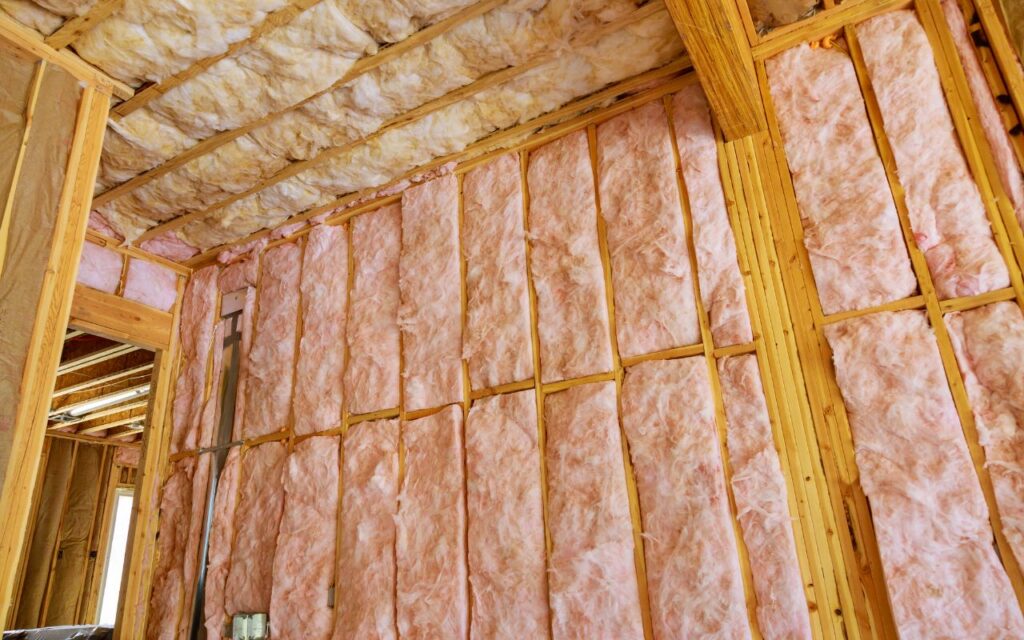
Which Knauf products should you choose for sound insulation?
There is no single Knauf product suitable for all applications. You need one type of material for a lightweight plasterboard wall, another for a ceiling, and yet another for a load-bearing screed.
Knauf Unifit 032 and 035 for partition walls
Unifit 032 and Unifit 035 are glass wool products that can be used in lightweight structures, including partition walls and ceilings. Their flexibility makes it easy to fill the spaces between the profiles precisely.
Unifit 032 has a λ-value of approximately 0.032 W/(m·K), whilst for Unifit 035 this value is approximately 0.035 W/(m·K). The specific thicknesses and widths available depend on the product variant, so please check the current technical data sheet before purchasing.
When choosing insulation, do not base your decision solely on the lowest lambda value. If the material is to be used to fill a plasterboard wall, it is more important to ensure that the thickness matches the profile and that the insulation can be laid tightly.
Knauf Ekoboard and Akustik Board – panels for acoustic installations
Knauf Ekoboard is a glass wool board designed for use in interior fittings. Its rigid form makes it ideal for use where you need a stable way to fill a space, for example in certain types of service ductwork or ceilings.
Products referred to as acoustic panels may be suitable for more demanding structures, but their specifications should always be checked for the specific variant. Not every product with a higher density will automatically provide greater insulation for the entire wall.
| Product | Form | Typical application | What to look out for |
| Unifit 032 | Roll | Plasterboard walls, ceilings | Thickness and tightness of the installation |
| Unifit 035 | Roll | Plasterboard walls, lightweight partitions | Adaptation to the structure |
| Ekoboard | Album | Interior fittings, ceilings | Stiffness and thickness |
| Acoustic panels | Album | More challenging developments | Specifications of a particular variant |
Diagram showing how to install mineral wool in a plasterboard partition wall
- Prepare the substrate. Check that the walls are plumb and level, and plan the layout of the structure. Mark the position of the UW profiles on the floor and ceiling.
- Fit the UW profiles. Apply sealing tape under each guide profile. This will prevent direct contact between the profile and the substrate and reduce the transmission of vibrations.
- Fit the CW profiles. Adjust the spacing of the posts to suit the wall system, usually using a spacing of 600 mm. Position the CW profiles in the UW in accordance with the system’s installation instructions and do not brace them in a way that would restrict the structure’s movement.
- Trim the wool. Measure the distance between the profiles and cut the material so that it fits the space exactly. With elastic wool, a small amount of excess makes it easier to achieve a tight fit.
- Insert the wool between the profiles. The material should fill the entire space without any gaps, large creases or gaps around the profiles. Do not leave any gaps around the installations.
- Check for leaks. Before closing the structure, inspect the entire surface. Pay particular attention to the corners, where different materials meet, and where cables pass through.
- Fit the first layer of plasterboard. Screw the panels to the framework in accordance with the system instructions. Take care when making the joints and ensure that no gaps form.
- Add a second layer of panels if the design requires it. Offset the joints from the first layer. Increasing the thickness of the cladding can significantly improve the sound insulation of the entire wall.
- Finish the job. Fill the joints between the panels and prepare the surface for further work. Seal all joints in accordance with the manufacturer’s system.
Once the work is complete, pay attention to the acoustic details. Ensure that the areas around sockets, switches, the floor and the ceiling are properly sealed. Even minor leaks can reduce the actual insulation performance of the finished partition.
FAQ – frequently asked questions about acoustic insulation wool
How many centimetres of mineral wool are needed on a partition wall to ensure good acoustics?
In a standard partition wall, the mineral wool should, first and foremost, completely fill the space between the profiles. For CW 75 or 100 mm profiles, mineral wool of the corresponding thickness is therefore usually used. If higher insulation performance is required, the use of a double grid, a greater number of board layers and the careful elimination of acoustic bridges may be more important than simply increasing the thickness of the insulation.
Does mineral wool dampen impact noise?
Mineral wool is very effective at reducing airborne sound, such as conversation, music or the television, but it does not, on its own, solve the problem of impact sound. Footsteps and impacts are transmitted through the building structure, which is why they must be reduced, first and foremost, at the point of origin. For this purpose, specially designed floating floors with acoustic insulation are used in flooring systems.
How does acoustic wool differ from thermal wool?
It is often the same type of material, but different properties are taken into account when making a choice. In the case of thermal insulation, the λ value is the most important factor, whilst in acoustic solutions, factors such as thickness, elasticity, fibre characteristics and the parameters of the entire partition, such as Rw or ΔRw, are significant. You should therefore not choose acoustic wool solely on the basis of its density.
Does mineral wool in a suspended ceiling help to soundproof a room?
Yes, mineral wool installed above a suspended ceiling can reduce the transmission of airborne sound through the ceiling. Its effectiveness depends on the thickness and properties of the wool, the ceiling structure and the airtightness of the entire system. If the main problem is footfall noise from the floor above, a solution is also required at the source of the sound.
What density of mineral wool is required for sound insulation?
There is no single density suitable for every application. Flexible glass wool with a relatively low density is often used in lightweight partition walls and ceilings, whilst floating floors require special boards with appropriate mechanical properties. When selecting a material, check first and foremost the specifications intended for the specific application and the structure as a whole, rather than the density value alone.


