






Blog
Knauf Goldband – gypsum plaster for interiors: properties and uses

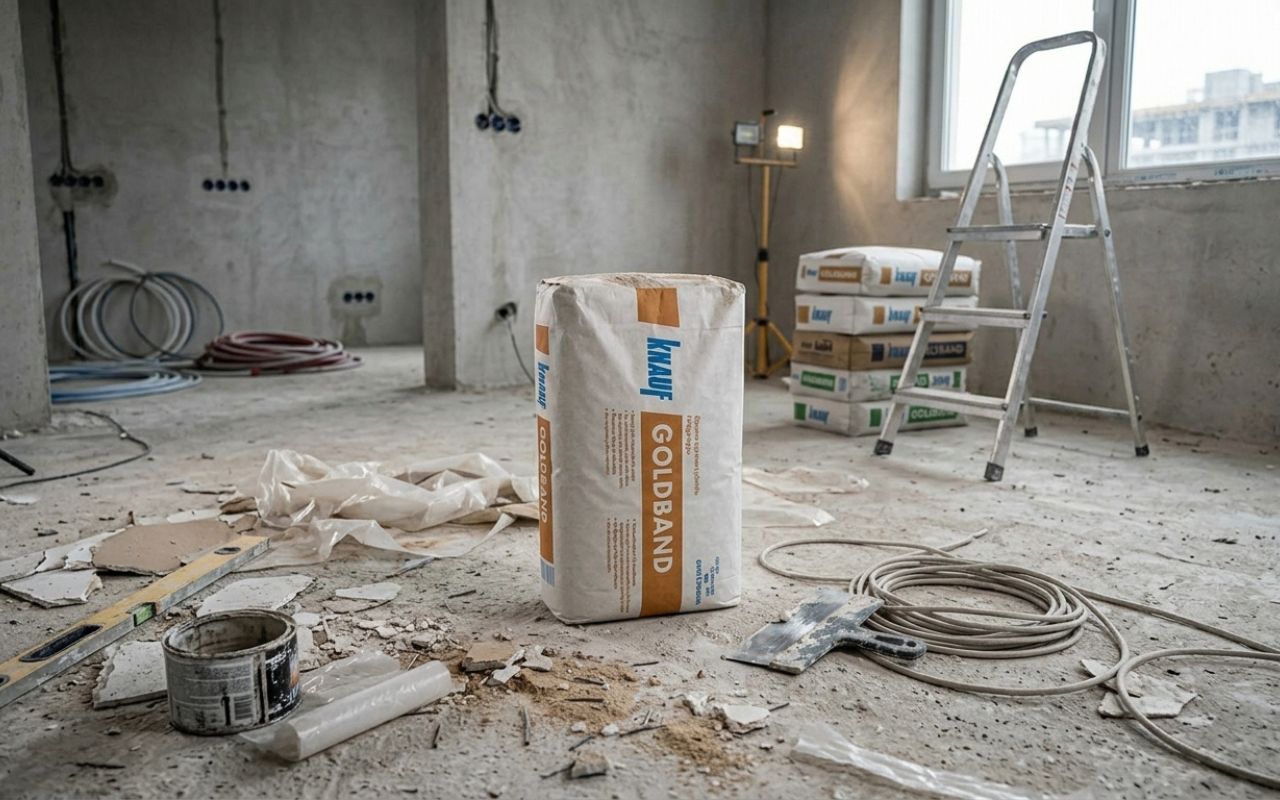
Knauf Goldband is a hand-applied gypsum plaster for interiors. It is suitable for brick, aerated concrete blocks and concrete, and when applied correctly, it provides a smooth surface for further finishing. Find out what it is used for, how to apply it, and when to choose this product over another.
Table of contents
What is Knauf Goldband?
Knauf Goldband is a ready-mixed, dry gypsum plaster designed for the manual application of single-layer interior plaster finishes. When mixed with water, it forms a paste which can be applied to mineral substrates on walls and ceilings, and then levelled and smoothed.
This is a KNAUF product designed primarily for jobs where there is no need to use a plastering machine. Goldband is therefore well suited to flat renovations, finishing individual rooms, work on detached houses, or areas where it is difficult to bring in the equipment required for machine plastering.
Knauf Goldband is available in several pack sizes, but the 30 kg Knauf Goldband is particularly popular. This size of bag makes it easy to plan your purchases when working on larger areas, whilst avoiding the need to order a whole pallet for smaller renovation projects.
The manufacturer describes Goldband as a hand-applied gypsum plaster for creating single-layer finishes on interior surfaces. The material is mineral-based, regulates humidity and is vapour-permeable. It can be used as a base for paint, wallpaper, ceramic tiles, as well as plasters and finishing compounds.
Composition and technical properties of Knauf Goldband
The most important thing is that Goldband is not a product that requires several different layers of plaster simply to achieve a smooth surface. With a properly prepared substrate, it can be used as single-layer gypsum plaster.
The current Knauf technical data sheet specifies the following parameters:
| Parameter | Knauf Goldband |
| Type | hand-applied gypsum plaster |
| Standard | EN 13279-1 |
| Classification | B1/20/2 |
| Minimum plaster thickness | 8 mm |
| Average plaster thickness | 15 mm |
| Maximum thickness | up to 50 mm |
| Wear at 15 mm | approx. 13 kg/m² |
| Performance | 100 kg = approx. 115 litres of mortar |
| Processing time | approx. 90 mins, depending on the surface |
| Compressive strength | ≥ 2.0 N/mm² |
| Bending strength | ≥ 1.0 N/mm² |
| Traction | ≥ 0.1 N/mm² |
| Reaction to fire | A1 |
| Diffusion resistance coefficient μ | 10 |
| Thermal conductivity λ | 0.34 W/mK |
| Temperature during the work | from +5°C |
The data is taken from the current Goldband technical data sheet issued on 24 July 2026.
It is worth paying attention to the thickness of the layer. As a standard, the manufacturer specifies an average of 15 mm, whilst under certain conditions a layer of up to 50 mm can be applied. For thicknesses exceeding 35 mm, Knauf recommends applying the plaster in two layers, as the drying time is significantly longer with a single thick layer. On concrete ceilings, Goldband should be applied in a single layer, up to a maximum of 15 mm.
Goldband also has an A1 fire reaction class, and its performance characteristics include moisture regulation and vapour permeability. As a result, this gypsum plaster can help maintain more stable humidity conditions indoors. However, this does not mean that it is suitable for areas that are constantly wet – its suitability depends on the operating conditions of the entire partition.
What is Knauf Goldband used for – applications
Knauf Goldband is primarily used to create smooth surfaces on walls and ceilings inside buildings. The manufacturer approves its use on various types of mineral substrates, so it can be used in both new-build and renovation projects.
In practice, Goldband can be used, amongst other things, on:
- ceramic bricks,
- walls made of mineral materials,
- concrete, once it has been properly prepared,
- on substrates with varying degrees of absorbency, following the application of a suitable primer,
- other mineral-based building substrates.
Goldband can be used as a base for paint and wallpaper, as well as for ceramic tiles. However, if you are planning to lay tiles, there are additional requirements regarding thickness and surface preparation. The current technical data sheet states that the plaster beneath the tiles should be at least 10 mm thick, applied in a single layer, and its surface should not be smoothed or trowelled. Before tiling, the residual moisture content of the substrate must not exceed 1%.
Importantly, Goldband can also be used in rooms with relative humidity of up to 70%, including kitchens and bathrooms subject to normal use. However, this should not be equated with resistance to direct and prolonged exposure to water. In areas exposed to splashes of water, appropriate waterproofing and a suitable finishing system are required. In such cases, Knauf recommends, amongst other things, the use of waterproofing and a suitable tile adhesive.
It is also worth distinguishing between Goldband and Goldband Finish. Goldband Finish is a ready-to-use, thin-layer polymer-based finishing coat designed for the further finishing of selected surfaces. It is therefore not a second variant of Goldband plaster, but a separate material for finishing work.
Knauf Goldband – a step-by-step guide to application
Goldband is designed for manual application, but a good result depends primarily on the preparation of the substrate. Simply mixing the powder with water is not enough – the plaster must have adequate adhesion to the substrate and be of the correct thickness.
Preparing the substrate before applying Goldband
The substrate should be load-bearing, stable, clean and free from dust, loose particles and any residues that might impair the adhesion of the plaster. Any significant unevenness must be removed, and the concrete substrate should have a residual moisture content of no more than 3%.
The type of preparation depends on the surface. In the case of smooth concrete, Knauf recommends using a primer to improve adhesion, e.g. Betokontakt or Spraykontakt. For walls with excessive or highly variable absorbency, the manufacturer recommends a suitable primer, whilst existing gypsum and gypsum-lime plasters can be prepared using Tiefengrund.
This is an important step that should not be overlooked. The same Goldband product may behave quite differently on absorbent brick, smooth concrete or a substrate with uneven absorbency. The primer is therefore selected to suit the specific surface, rather than following the „one product fits all” principle.
During application, the room and substrate temperatures should not be below +5°C. Fresh plaster must be protected from frost.
Mixing and applying Goldband plaster
To prepare Goldband, you will need, first and foremost, a clean container, water, a mixer, and tools for applying and finishing the plaster. The current technical data sheet specifies approximately 18 litres of water per 30 kg bag. The material should be mixed with water, without any additives, until the correct consistency is achieved.
Once prepared, the mixture is applied by hand and then spread and levelled using a trowel. Once setting has begun, the surface can be further worked to smooth out minor irregularities. The next stage involves moistening the surface and working it with a sponge trowel, followed by smoothing with a suitable tool.
The working time is approximately 90 minutes, but this depends on the type of substrate and the conditions in the room. It is therefore not advisable to prepare more mortar than you are able to use within that time.
As a rule, the minimum plaster thickness is 8 mm, and the average is 15 mm. With thicker layers, a longer drying time must be allowed for. If the wall comprises substrates with different characteristics, e.g. a combination of brick and concrete, the manufacturer recommends using fibreglass mesh reinforcement.
Drying time and aftercare following application
Do not automatically assume that Goldband will dry out in a few days. The current Knauf technical data sheet states that for a 10 mm-thick layer, the average drying time is approximately 14 days, although this depends on the temperature, humidity and ventilation in the room. Under less favourable conditions, it may take longer.
The best way to speed up the process is to ensure proper ventilation. However, this does not mean aggressively drying out the plaster with a heater or directing a very intense stream of warm air at it. The plaster should dry evenly.
Before painting or applying the next coat, the surface must be dry, stable and free from dust. Knauf also recommends using a suitable primer before applying a coat of paint or other finish.
Knauf Goldband vs other gypsum plasters – a comparison
Knauf Goldband is not the only gypsum plaster produced by Knauf. The choice depends primarily on the method of application, the type of substrate, the surface and the conditions of use.
Goldband vs Knauf MP 75 – which one should you choose?
The simplest difference is this: Goldband is applied by hand, whilst MP 75 is applied by machine. Knauf MP 75 is designed for applying single-layer gypsum plasters using a spraying machine and can also be applied to a thickness of up to 50 mm.
| Criterion | Knauf Goldband | Knauf MP 75 |
| Method of application | manual | mechanical |
| Type of work | renovations, small and medium-sized spaces | large areas |
| Equipment | basic plastering tools | plastering machine |
| Work efficiency | reliant on manual labour | high for a large property |
| Application | internal walls and ceilings | internal walls and ceilings |
| Thickness | up to 50 mm | up to 50 mm |
If you’re plastering a single room, a flat during renovation, or a few small areas, applying Goldband by hand may be more convenient. For a large house, a property development project or an area of several hundred square metres, the speed of machine application is far more important.
If you’re interested in solutions for larger spaces, read this post: Knauf MP 75 – machine-applied gypsum plaster and check out the category Knauf machine-applied gypsum plasters.
Goldband vs cement-lime plaster – differences and applications
Goldband and cement-lime plaster have different properties and should not be treated as substitutes in every application. Goldband is a solution for interiors where easy manual application, the ability to achieve a smooth finish and the properties characteristic of gypsum plasters are important. Cement-lime plasters, on the other hand, are often chosen where different material properties and greater resistance to specific operating conditions are required.
| Criterion | Goldband | Cement-lime plaster |
| Type | plaster | cement-lime |
| App | manual | by hand or by machine, depending on the product |
| Main application | interiors | interiors and selected outdoor applications |
| Finish | smooth after appropriate treatment | depending on the type of plaster and finish |
| Humidity control | yes | depends on the product |
| Wet rooms | only under certain conditions | depending on the product |
If you’re wondering which material would be best for a particular room, it might be helpful to compare Cement-lime plaster – when should you choose it?. The choice should be based on the type of substrate, moisture content, the planned finish and the conditions of use, rather than solely on the price per bag.
How do you work out how much Goldband you need per m²?
The simplest way is to first calculate the total surface area of the walls and determine the average thickness of the plaster. You can then use the coverage figures provided by the manufacturer.
With a consumption of approximately 13 kg/m² for a 15 mm layer:
50 m² × 13 kg = 650 kg
650 kg ÷ 30 kg = 21.67 sacks, which means you’ll need 22 bags; when buying them, it’s worth allowing for an extra supply to account for uneven ground and material wastage.
If the average thickness is lower, the consumption will also fall. However, one should not assume a single value in kg/m² for every wall – the actual consumption depends on the thickness of the plaster and the characteristics of the substrate. The manufacturer itself points out that the exact consumption should be determined directly on site.
For a major renovation, it is therefore worth calculating the amount of material required based on the actual unevenness of the walls, rather than just the floor area. If the shop provides a materials calculator, you can also use it to quickly estimate the quantity you will need.
Where can I buy Knauf Goldband at the best price?
You can buy Goldband both from high-street building supplies shops and online. When making a purchase, it is worth considering not only the price per bag, but also the availability of a specific variant, the delivery cost and whether you can get a better price for a larger order.
PK Complex sells Knauf products online and delivers building materials. For larger renovation projects, it’s worth specifying the planned number of bags straight away and asking for a personalised quote – especially if you’re ordering other materials needed for plastering at the same time.
If you’re not sure how much material you need or which plaster will be suitable for a particular surface, you can consult our advisor before making your purchase. It’s easier than ordering a random product and then having to buy more material or replace the wrong one.
Knauf Goldband at the PKComplex shop You can order online by checking the current price and availability of the product. For larger orders, it’s worth asking straight away whether a bespoke quote can be provided.
FAQ – Frequently Asked Questions about Knauf Goldband
Is Knauf Goldband suitable for use in a bathroom?
Yes, Knauf Goldband can be used in bathrooms subject to normal use, with air humidity of up to 70%. However, this does not mean it is resistant to direct and constant contact with water; therefore, in splash zones, appropriate waterproofing and the use of a suitable finishing system are essential.
How many bags of Goldband do I need for 50 m² of wall?
Assuming an average plaster thickness of 15 mm, the manufacturer states a consumption rate of approximately 13 kg/m². For 50 m², this amounts to approximately 650 kg, or 22 bags of 30 kg each, not including any extra allowance for unevenness in the substrate and material wastage.
How long should Knauf Goldband be left to dry before painting?
For a 10 mm thick layer, the average drying time is around 14 days, but this depends on the temperature, humidity and ventilation in the room. Before painting, the plaster must be dry, stable and free from dust, and the final waiting time should be adjusted to the actual conditions on site.
Can Knauf Goldband be applied by machine?
No, Knauf Goldband is designed for manual application. If you wish to apply plaster using a machine, choose a product designed for machine application, such as Knauf MP 75.
How does Knauf Goldband differ from Knauf Rotband?
Both products are gypsum-based hand-applied interior plasters, but Rotband has been developed as a plaster with enhanced adhesion and is particularly recommended for difficult substrates, such as smooth concrete. Goldband, on the other hand, is a universal gypsum-based hand-applied plaster for mineral substrates, intended for the application of single-layer interior plaster finishes.


