


Blog
Knauf mineral wool – product overview, applications and prices

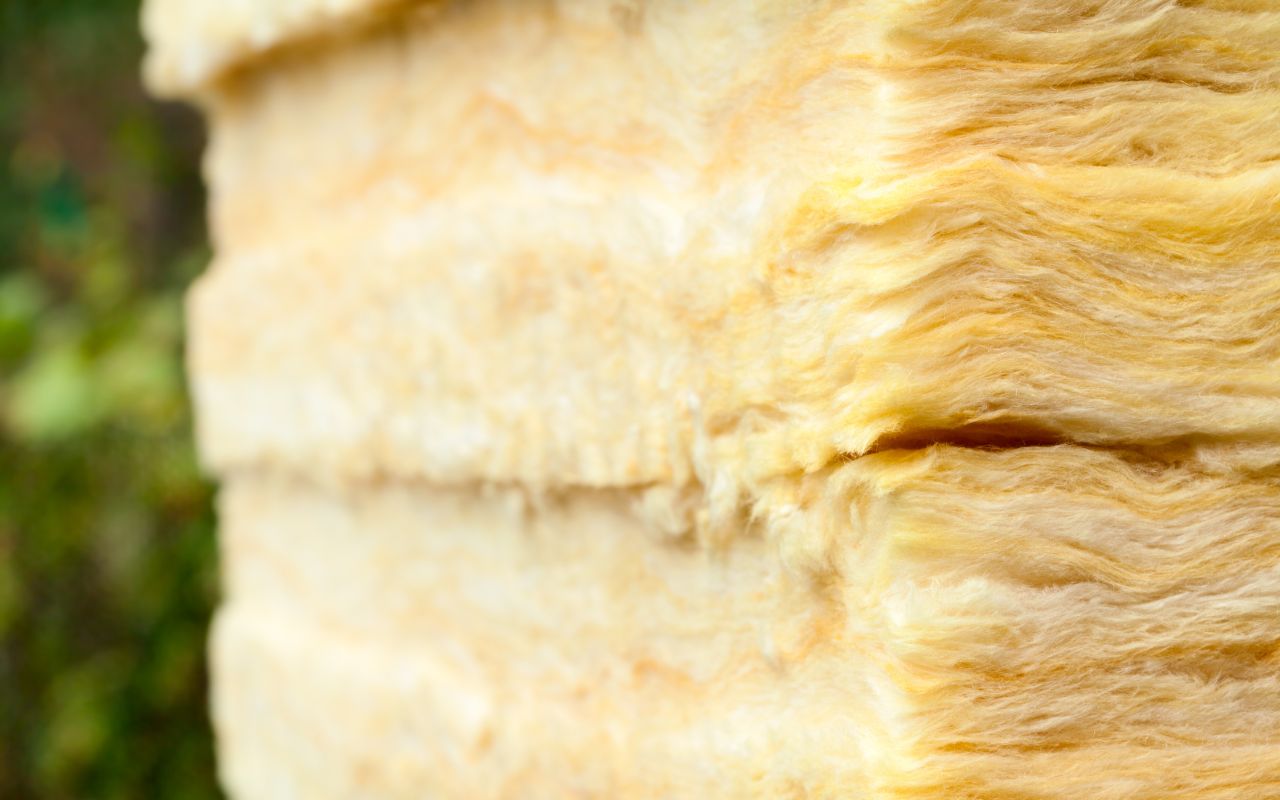
Knauf mineral wool is one of the most popular insulation materials in Poland, and for good reason. If you’re looking for a tried-and-tested product for insulating your loft, ceiling or façade, one that combines genuine quality with an affordable price, you’ve come to the right place. In this post, you’ll find a comprehensive overview of Knauf’s product ranges, a thickness selection table, indicative prices and answers to the most frequently asked questions. Read on to find out more!
Key findings
- Knauf mineral wool is a tried-and-tested solution for insulating attics, ceilings, partition walls and façades.
- The most popular choice for attics is Knauf Unifit 035, which offers very good value for money.
- The lower the lambda (λ) coefficient, the better the thermal insulation for the same material thickness.
- To meet the current WT 2021 requirements, it is advisable to install at least 20–25 cm of insulation in the loft.
- Mineral wool not only provides protection against heat loss, but also offers excellent acoustic properties and high fire resistance.
- Thanks to the official partnership between PK Complex and Knauf, customers are guaranteed genuine products, expert advice and competitive prices, with the option to negotiate.
Table of contents
Knauf mineral wool – why choose this brand?
Knauf is a global manufacturer of building materials with several decades’ experience. The brand has been present in Poland since the 1990s and is now one of the market leaders in the thermal and acoustic insulation sector. But why choose Knauf over a cheaper alternative?
- Consistent production quality – every batch meets the same stringent specifications as set out in the technical data sheet.
- A wide range — from wool in rolls to rigid façade panels — all sourced from a single manufacturer and fully compatible with one another.
- Availability – Knauf products are in stock all year round, with no issues regarding seasonal shortages.
- Technical support – Knauf provides comprehensive technical documentation, product data sheets and insulation calculators.
PKComplex’s official partnership with Knauf – what does this mean for you?
PKComplex is an official Knauf trading partner, which in practice means a few specific things: you buy only genuine products directly from an authorised distribution channel, you have access to the full range of the product line (not just selected SKUs), and for larger orders you can always negotiate the price – Negotiations are certainly possible.
A material quantity calculator is available for every product in the shop – simply enter the surface area, select the thickness, and you’ll know straight away how many rolls or sheets to order. And if anything is unclear, our advisor will guide you through the entire process – from product selection to delivery.
Technical specifications of Knauf wool – what do ‘lambda’ and ‘fire reaction class’ mean?
The thermal conductivity coefficient, lambda (λ), is the most important figure on the wool packaging. The lower the λ, the better the material insulates – and the thinner the layer, the better it is for meeting the same thermal requirements.
Example: at a thickness of 15 cm, wool with λ = 0.032 achieves a thermal resistance of R ≈ 4.69 m²K/W, whilst wool with λ = 0.042 yields only R ≈ 3.57 m²K/W. This represents a difference of over 30% in insulation efficiency for the same thickness. In practice, this means lower heating bills or the option to use a thinner layer where space is limited.
Knauf mineral wool is classified as A1 or A2 – meaning it is non-flammable. This is a fundamental difference compared to polystyrene (class E), which is particularly important when insulating attics, flat roofs and partition walls.
Mineral wool is also vapour-permeable – it ‘breathes’, which eliminates the risk of water vapour condensation within the structure when a vapour barrier or vapour-permeable membrane is used correctly.
Certificates and standards – Knauf wool and the requirements of Polish building regulations
All Knauf products carry a Declaration of Performance (DoP), bear the CE marking and comply with the PN-EN 13162 standard relating to thermal insulation products for use in construction.
Since 2021, stricter Technical Specifications (WT 2021) have been in force, which set out the minimum thermal resistance values for building partitions. For a pitched roof, this is R ≥ 6.20 m²K/W, which, with λ = 0.035, corresponds to an insulation layer with a thickness of at least 22 cm. Knauf wool meets all current requirements – you simply need to choose the right thickness.
Types of Knauf mineral wool – which product should you choose?
Below you will find an overview of all the main Knauf product ranges available at the PK Complex shop. The table will help you quickly find the right product for your application – you can read the details in the following sections.
| Product | Form | Lambda (λ) | Main application |
|---|---|---|---|
| Knauf Unifit 032 | Records | 0.032 W/(m·K) | Attics – between the rafters, maximum insulation |
| Knauf Unifit 033 | Records | 0.033 W/(m·K) | Attics – between the rafters, high efficiency |
| Knauf Unifit 035 | Records | 0.035 W/(m·K) | Attics – a bestseller, the best value for money |
| Knauf Unifit 037 | Records | 0.037 W/(m·K) | Attics and ceilings – applications with lower requirements |
| Naturoll 042 | Roller skates | 0.042 W/(m·K) | Wooden ceilings, floors on joists |
| Naturoll Plus 040 | Roller skates | 0.040 W/(m·K) | Unused attics, ceilings – a good compromise |
| Naturoll Pro 039 | Roller skates | 0.039 W/(m·K) | Attics and ceilings – the best performance in the roller series |
| Naturboard 035 | Rigid panels | 0.035 W/(m·K) | Ventilated façades – between the structural mullions |
| FKD-N Thermal L34 | Facade panels | ~0.034 W/(m·K) | ETICS systems, rendered façades |
Knauf Unifit — wool insulation in panels between rafters and purlins
The Unifit range consists of resilient glass wool boards designed primarily for insulating pitched roofs and timber ceilings – laid between rafters, purlins or ceiling joists.
Key advantage: the elasticity of the wool means it stays in place on its own thanks to a slight oversize (a few centimetres wider than the rafter spacing) – without the need for glue, mechanical fasteners or wasting time.
- Unifit 032 / 033 – premium for the discerning. The lowest λ value in the range means you can use a thinner layer and still comply with WT 2021. Ideal where the rafters are low.
- Unifit 035 – the most popular choice in Poland. Excellent value for money, available in thicknesses ranging from 10 to 20 cm.
- Unifit 037 – a cost-effective option for situations with lower thermal requirements or where double-layer insulation is used.
If you’re building or renovating an attic and don’t know where to start – take a look at what we have to offer Knauf Unifit 035 wool, which covers most common applications.
Knauf Naturoll and Naturoll Plus – roll-form insulation for attics and ceilings
Rolls are ideal for large, open spaces – wooden ceilings, floors on joists or unused attics. Less cutting, quicker installation, less waste. The Naturoll range offers three options:
- Naturoll 042 – a cost-effective option for ceilings without high thermal requirements. A lambda value of 0.042 means a thicker layer, but also a lower price per m².
- Naturoll Plus 040 – the happy medium. Better insulation than the standard 042 at a similar price.
- Naturoll Pro 039 – the best specification in the roll series. A good choice if you prioritise efficiency but prefer the roll format.
Knauf Naturboard – rigid boards for ventilated façades
Naturboard 035 These are rigid, lamellar panels designed for ventilated façades – installed between or in front of the supporting grid. Rigidity is key: the panels do not deform under their own weight, which is important for vertical façade surfaces. A lambda value of 0.035 ensures good thermal performance with a moderate thickness.
Knauf FKD – facade insulation for ETICS systems
FKD-N Thermal L34 This is insulation wool designed for external thermal insulation composite systems (ETICS), commonly known as 'plaster on wool’. Its high tensile strength perpendicular to the surface (TR) ensures that the wool adheres to the adhesive and does not fall away beneath the plaster mesh. A lambda value of ~0.034 is one of the best in the façade sector.
Supafil Loft blown-in wool – a modern alternative
Supafil Loft is loose-fill glass wool designed for machine-blown installation on flat ceilings and unused attics. It fills all gaps and nooks and crannies without creating any thermal bridges – a particularly valuable feature in renovation projects where access to the ceiling is limited. It requires specialist blowing equipment, but the insulation effect is exceptionally uniform.
Knauf wool thicknesses – selection table for various applications
Choosing the right thickness of insulation is one of the most frequently asked questions – and rightly so, as it determines whether your home will meet the WT 2021 requirements and how much you’ll save on heating. The table below gives approximate thermal resistance (R) values for wool with a thermal conductivity (λ) of 0.035. *R-values for λ = 0.035.
| Thickness | R [m²K/W]* | What do you achieve? | When to use | Recommended product |
|---|---|---|---|---|
| 15 cm | ~0.67–0.94 | Extensions and refurbishments where space is limited | Buildings outside the WT 2021 scheme, renovations | Unifit 032/033 |
| 20 cm | ~0.95–1.25 | Converted attics — WT 2021 standard | New houses, attics with standard rafter heights | Unifit 035 |
| 25 cm | ~1.25–1.56 | Energy-efficient and passive houses | Attics with high rafters or two floor plans | Unifit 032/033 |
| 30 cm + | ~1,56+ | Passive construction / ultra-nZEB | Projects with an energy performance certificate | Unifit 032 |
15 cm of wool – when is it enough, and when is it not enough?
15 cm of mineral wool (λ 0.035) gives an R-value of ≈ 4.28 m²K/W – this is below the WT 2021 requirement for a pitched roof (R ≥ 6.20). A 15 cm layer is not sufficient as the sole form of insulation in new-build properties, but it works well as part of a two-layer insulation system (e.g. 15 cm between the rafters + 5 cm beneath the rafters) or in the refurbishment of older buildings, where improving thermal performance is important but there is not enough space for thicker layers.
20 cm wool – the gold standard for converted lofts
20 cm of mineral wool (λ 0.035) = R ≈ 5.71 m²K/W. This is still slightly below the WT 2021 requirement, but in combination with an additional layer between the rafters or beneath the rafters, you will easily achieve the required level. For most standard rafters with a height of 20 cm The Unifit 035, with a thickness of 200 mm, is the most popular choice by Polish performers.
Wool 25 cm and thicker – when is thicker insulation worth it?
25 cm at λ 0.032 gives R ≈ 7.81 m²K/W – well above the WT 2021 requirements. This level of insulation pays off in energy-efficient and passive houses, where every additional m²K/W translates into a saving of several dozen zlotys on bills per season. With the more expensive premium wool (λ 0.032), a thickness of 25 cm is often more cost-effective than 30 cm of a cheaper product with λ 0.042.
How do you convert wool thickness into energy savings?
The formula is simple: R = d / λ, where d is the thickness in metres. The higher the R-value, the lower the heat loss through the partition. The actual savings depend on the price of energy, the roof area and the climate – but investing in the right thickness of insulation usually pays for itself within 5–10 years through lower heating bills.
Uses of Knauf mineral wool – where can it be used?
Attic insulation – wool between and beneath the rafters
Converted lofts are the most common application for mineral wool. The standard layout is double-layer insulation: the first layer fills the space between the rafters (Unifit 035 or Unifit 032/033), whilst the second – laid crosswise beneath the rafters – eliminates thermal bridges. A total thickness of 20–25 cm usually meets the requirements of WT 2021.
You can find a detailed installation guide in the article: How to insulate an attic with mineral wool, step by step.
Insulating flat roofs and roof decks
On flat roofs and roof decks, the insulation is laid as a continuous layer – without rafters to support it. Stiffer boards or blown-in insulation (Supafil Loft) work well here. It is essential to ensure an adequate slope for water drainage and to position the vapour barrier correctly on the warm side.
Partition walls and soundproofing of rooms
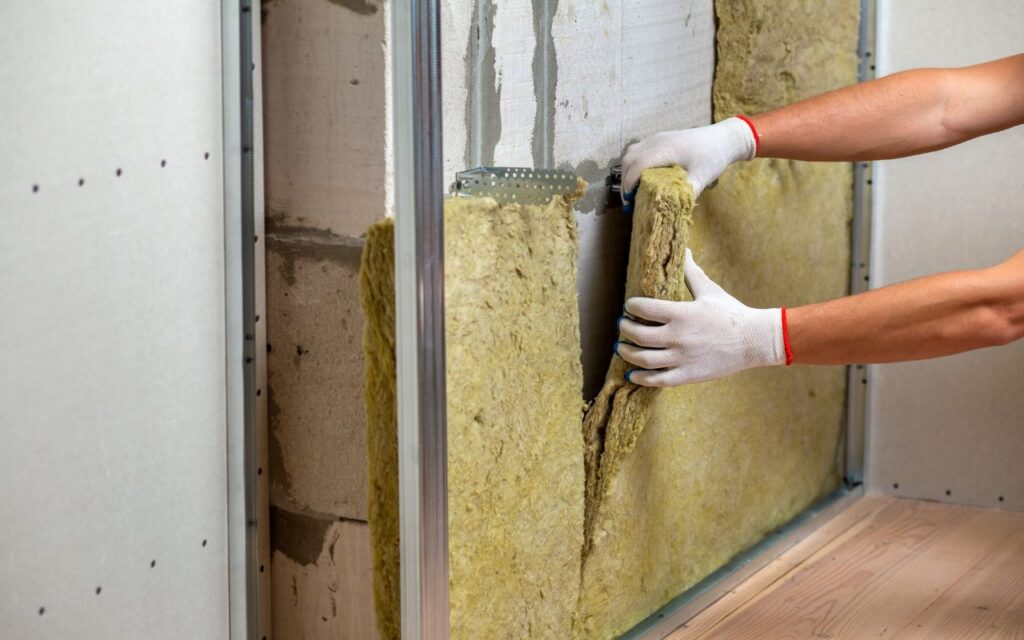
Mineral wool is just as effective at sound insulation as it is at thermal insulation. In partition walls, it fills the space between the studs, absorbing airborne sound (voices, music, TV). For acoustic applications, it is advisable to choose products with a density of at least 30–40 kg/m³ – ask our adviser about current availability.
Ventilated façades – insulation on the façade
Ventilated façades require insulation that does not deform under its own weight – hence the rigid Naturboard 035 panels. The system works simply: the boards are fixed to a battens (wooden or metal), and a ventilation gap remains between them and the cladding, which allows moisture to escape. The result? A dry wall and lower bills all year round.
Prices of Knauf mineral wool – how much will you pay?
The prices of Knauf mineral wool depend on several factors: the product form (roll / board / rigid board), the lambda value, the thickness and the quantity ordered. Approximate price ranges for popular products, per m²:
- Naturoll 042 (rolls, ceilings): approx. 7–14 PLN/m² for standard thicknesses
- Unifit 035 (panels, lofts): approx. 12–22 PLN/m² depending on thickness
- Unifit 032/033 (premium): approx. 21–30 zł/m²
- Naturboard 035 / FKD-N (facades): approx. 25–45 PLN/m²
Please note: A lower price per m² does not always mean you’ll save money – Wool with a λ value of 0.042 requires a thicker layer to achieve the same effect as products with a λ value of 0.032. When comparing quotes, calculate the cost per unit of thermal resistance (R), not per square metre. You can find a detailed analysis in the article: How much does mineral wool cost?.
Price per m² versus price per roll/pack – how should you compare them?
Manufacturers quote prices in different ways – one quote shows the price per pack, another per m², and yet another per m³. To compare them properly: check the thickness, work out how many m² are in a pack or roll, and work out the price per m². At the PK Complex shop, prices are quoted transparently – for each product, you can see both the unit price and the price per square metre for the selected thickness.
How much Knauf wool do you need for the loft?
A simple calculation formula:
- Measure the roof area (not the floor area – there can be a difference of up to 20–30% on a steep roof)
- Add 5–10% to the waste and refuse
- Check how many square metres are contained in one pack/roll of a particular product
- Divide the total area by m² per pack → number of packs
At the PK Complex shop, every product has a built-in calculator – simply enter the dimensions and you’ll get a ready-made order list. And if anything’s unclear, just drop us a line or give us a call – we’ll help you without any unnecessary red tape.
FAQ – frequently asked questions about Knauf mineral wool
Is Knauf mineral wool vapour-permeable?
Yes – mineral wool is a vapour-permeable material (μ ≈ 1), which means that water vapour passes through it freely. This is an advantage when insulating lofts, but it requires the correct installation of a vapour barrier on the warm side and a vapour-permeable membrane on the cold side.
Which Knauf wool has the best lambda value?
In PK Complex’s standard range, Knauf Unifit 032 has the lowest λ value (λ = 0.032 W/(m·K)). In the façade segment, FKD-N Thermal L34 stands out with a λ value of ~0.034. The lower the λ value, the thinner the layer required to achieve the necessary thermal resistance.
Can Knauf wool be cut with a knife?
Yes – mineral wool (both Naturoll rolls and Unifit panels) can be cut easily with a sharp upholstery knife or a special wool knife. The easiest way to cut along a straight line is to use a shelf or a strip of wood as a guide. It is advisable to wear a dust mask and gloves whilst doing this – the fibres can irritate the skin and respiratory tract.
How should Knauf mineral wool be stored before installation?
Mineral wool does not absorb moisture, but cardboard packaging does. Store it in a dry, sheltered place, preferably raised off the ground on pallets. Do not stack the packages too high – they may become misshapen under their own weight if stored for a long time.
Is a vapour barrier required for Knauf wool?
When insulating pitched roofs from the inside – yes, a vapour barrier (or low-vapour-permeability membrane) on the warm side (inside the building) is essential. It prevents water vapour from the room from penetrating deep into the structure, where it could condense. On the external side, a vapour control layer (VCL) is used, which allows vapour to escape to the outside. For horizontal ceilings, the rules may differ – please ask our adviser.


